A Connecticut Certificate of Title Surety Bond provides a financial guarantee for vehicle ownership when the original title is missing, damaged, or improperly transferred, protecting the state and any third parties with legitimate claims. This bond allows vehicle owners to secure legal registration and title from the DMV when standard paperwork cannot be produced.
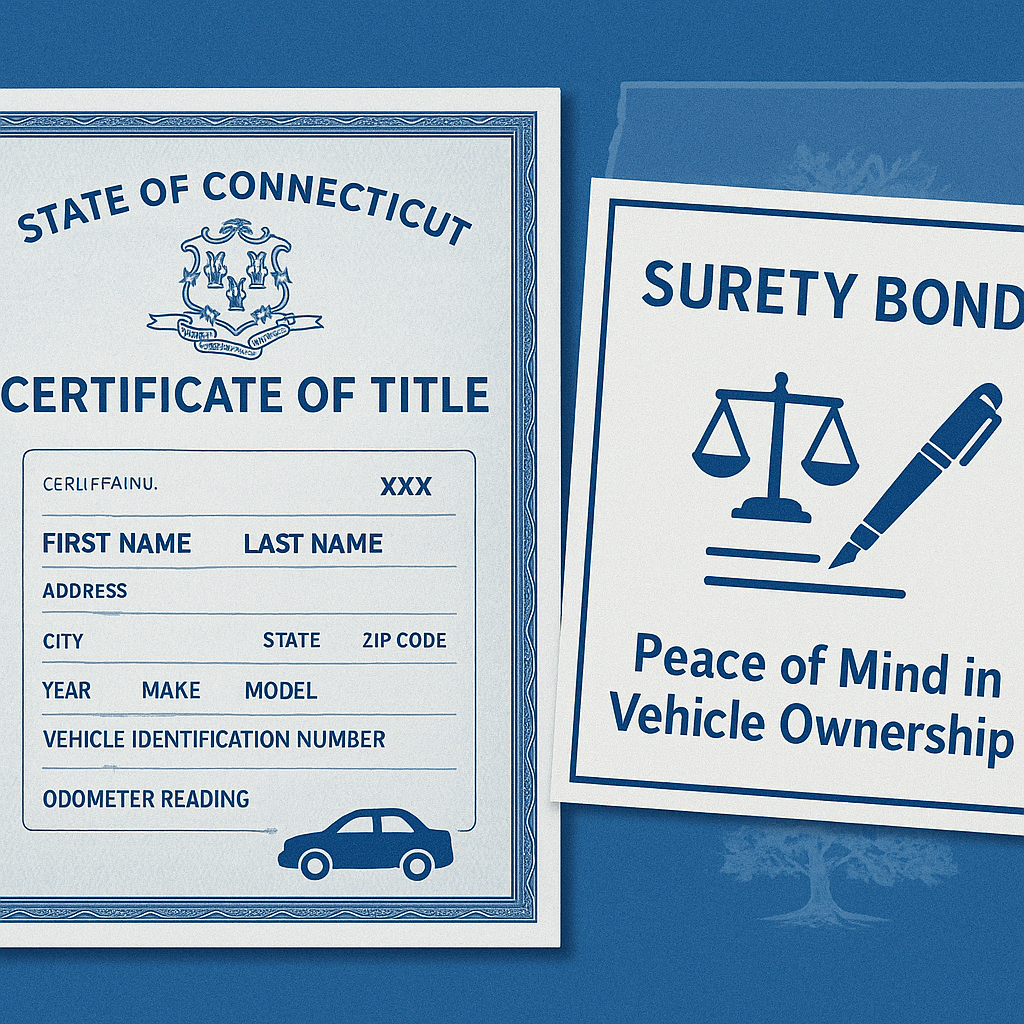
Imagine this: you just bought a used car from a private seller. The vehicle is exactly what you wanted, and the price was right. But when it comes time to transfer the ownership, you hit a wall. The title is missing, damaged, or was never properly signed over. What do you do now? You can’t register the car, you can’t get license plates, and you certainly can’t legally drive it. This is where a Connecticut Certificate of Title Surety Bond steps in to save the day.
If that term sounds like a mouthful, don’t worry. We’re going to break down exactly what it means, why you might need one, how it works, and how to get it. Think of this as your friendly, plain-English guide to bonded titles in the Nutmeg State.
So, What Exactly Is a Certificate of Title Surety Bond?
In simplest terms, a certificate of title surety bond—often called a bonded title or lost title bond—is a financial guarantee. It promises that you are the rightful owner of a vehicle and that there are no hidden claims or liens against it. If someone else later comes forward with a legitimate claim to the car (say, a previous owner who actually still owed money on it), the bond provides a way to compensate them for their loss. It protects the state of Connecticut, the public, and any wronged parties, all while allowing you to claim legal ownership.
This isn’t insurance for you. It’s a promise to the Connecticut Department of Motor Vehicles (DMV) that your ownership claim is solid. If it turns out your claim isn’t as clean as you thought, the bond money can be used to make things right. You, however, would then have to pay back the surety company that issued the bond. So, it’s serious business, but it opens the door when the standard paperwork route is blocked.
Why Would You Need a Bonded Title in Connecticut?
Life throws curveballs, and vehicle paperwork often gets lost in the shuffle. The Connecticut DMV won’t just take your word for it if you can’t produce a valid title. You’ll need a surety bond in several common situations:
- The title was lost, stolen, or destroyed. Maybe you misplaced it during a move, or a house fire took it. If the vehicle was last titled in your name, you might just need a duplicate title. But if it was never transferred into your name, a bond is often required.
- You bought a vehicle and never received a properly assigned title. The seller handed you keys and a bill of sale, but no title. They promised to mail it, then vanished. Now you have a car you can’t register.
- The original title is defective or incomplete. Perhaps it was signed in the wrong place, has a lien release missing, or contains errors that make the DMV reject it.
- You’re dealing with an abandoned vehicle or an estate settlement. When property changes hands after a death or a vehicle is left behind, the paperwork trail often gets muddy.
- You purchased a vehicle through a mechanic’s lien or storage auction where proper title documentation wasn’t provided.
In every one of these scenarios, the state wants to be sure you’re not trying to claim a stolen vehicle or skip out on an existing loan. The surety bond is their safety net.
How Does the Bond Work? A Simple Three-Party Handshake
Let’s make this super clear with an everyday analogy. Imagine you’re renting an apartment, and the landlord asks for a security deposit. That deposit protects the landlord if you damage the unit. A surety bond is similar, except instead of putting up your own cash as a deposit, you pay a smaller fee to a surety company, and they promise to cover any valid claim up to the bond amount.
There are always three parties involved:
- The Principal: That’s you, the vehicle owner who needs the bond.
- The Obligee: The Connecticut DMV, which requires the bond to protect the state and any prior owners or lienholders.
- The Surety: The insurance or bonding company that issues the bond and backs it financially.
If someone pops up with proof that they own the car or still have a loan on it, they can file a claim against the bond. The surety investigates. If the claim is legitimate, the surety pays out up to the bond’s limit. Then—here’s the kicker—they come to you for reimbursement. So, accuracy and honesty in your application are everything.
The Step-by-Step Path to Getting Your Connecticut Bonded Title
Now that you know the “why,” let’s walk through the “how.” The process might seem intimidating, but if you take it step by step, you’ll be holding that clean title sooner than you think.
Step 1: Visit the Connecticut DMV and Start the Paperwork
You can’t just order a bond online and call it a day. First, you need to go to a DMV hub office or a limited service office that handles titles. Bring everything you have: the vehicle, any bill of sale, old registration documents, photographs, and a completed application for title. The DMV will inspect the vehicle’s VIN and determine if you’re a candidate for a bonded title. If the vehicle is stolen or has an unsolvable title brand, the bonded route might be closed. Assuming you get the green light, the DMV will provide an official document stating the required bond amount.
Step 2: Determine the Bond Amount
The bond isn’t a random number. Connecticut requires the bond to be 1.5 times the vehicle’s current market value. So, if your car is worth $6,000 according to the DMV’s valuation guides, the bond amount will be $9,000. This multiplier gives an extra cushion to cover potential damages and costs beyond just the bare value of the car. The DMV will tell you the exact figure after their assessment.
Step 3: Shop for a Surety Bond
This is where a trusted surety bond provider enters the picture. You’re not buying the full bond amount. You pay a premium—a small percentage of that total. How small? It depends on your credit score and the underwriting. People with great credit might pay as little as 1% of the bond amount. For a $9,000 bond, that’s just $90. Those with shaky credit could pay 5% to 15%, so $450 to $1,350. The premium is a one-time fee that covers the bond for its entire term, usually three years. You can compare quotes online, but make sure the company is licensed to write surety bonds in Connecticut.
Step 4: Submit the Bond to the DMV
Once you’ve paid the premium, the surety company issues the official bond document. You then present this, along with all your other paperwork, to the DMV. They’ll process everything and issue you a bonded title. This title will have a notation indicating it’s bonded. That note sits there for three years. During that time, if a valid claim arises, the bond covers it. After the three-year period, if no claims have surfaced, the “bonded” brand is removed, and you can get a clean, unrestricted title just like any other vehicle.
What Does It Cost, Really?
Let’s talk numbers, because budgets matter. The total cost includes the bond premium plus standard DMV title and registration fees. Here’s a quick breakdown for a typical scenario:
- Vehicle value: $5,000
- Required bond: $7,500 (1.5 x value)
- Bond premium (assuming 3% rate): $225
- DMV fees: $25 title fee plus applicable registration and plate fees.
Keep in mind, if your credit is excellent, that $225 could drop to $75. If it’s poor, it might jump to $1,125. The bond cost is directly tied to the risk the surety sees in you.
Frequently Asked Questions About CT Title Bonds
Is a bonded title the same as a regular title?
Almost. It functions the same way for registration, insurance, and selling. The difference is the “bonded” brand that stays on it for three years. After that waiting period, you can apply for a standard, unbranded title.
Can I sell a car with a bonded title?
Yes. You can sell it, transfer it, or drive it cross-country. Potential buyers might have questions about the bonded status, but you can explain it’s a legal title that becomes clean after the period expires. Transparency goes a long way.
What if a claim is filed against my bond?
First, don’t panic. Claims are relatively rare, especially if you’ve done your due diligence to ensure no one else has a right to the vehicle. If a claim happens, the surety investigates. If it’s valid, they pay and then seek reimbursement from you. This reinforces the importance of exhausting all other ways to get a regular title before turning to a bond.
Does my driving record affect the bond cost?
No, this isn’t like auto insurance. It’s a financial instrument. The surety only cares about your credit history and overall financial stability, not speeding tickets.
Why a Bonded Title Beats Parking Your Car Indefinitely
Nobody wakes up hoping to deal with extra paperwork and fees. But consider the alternative: a vehicle sitting in your driveway, unregistered and unusable, while you desperately try to track down a seller who has disappeared or dig through decades-old records. The bonded title process exists for a reason—to give honest people a legal pathway to ownership when the original paper trail breaks. It transforms a frustrating dead-end into a manageable, though sometimes patience-testing, solution.
A Connecticut certificate of title surety bond isn’t a loophole; it’s a safeguard built into the system. It allows commerce and vehicle ownership to flow smoothly even when human error or missing documents throw up roadblocks. And once that three-year period passes, the whole episode becomes a distant memory. Your bonded title becomes a regular title, and you can move on with the open road ahead.
If you’re stuck in title limbo, visit your local DMV, get that bond determination, and then reach out to a reputable bond provider. With a little effort and the right paperwork, you’ll have those keys in the ignition and a legal set of plates in no time. Safe travels!