Contractors performing work that disturbs public streets or sidewalks in Brookline, Massachusetts must secure a street occupation permit bond, a three-party financial guarantee protecting the town against incomplete restoration or damage. The bond amount varies by project scope, and securing it involves determining the required permit and amount, then applying through a surety company before the Department of Public Works issues the permit.
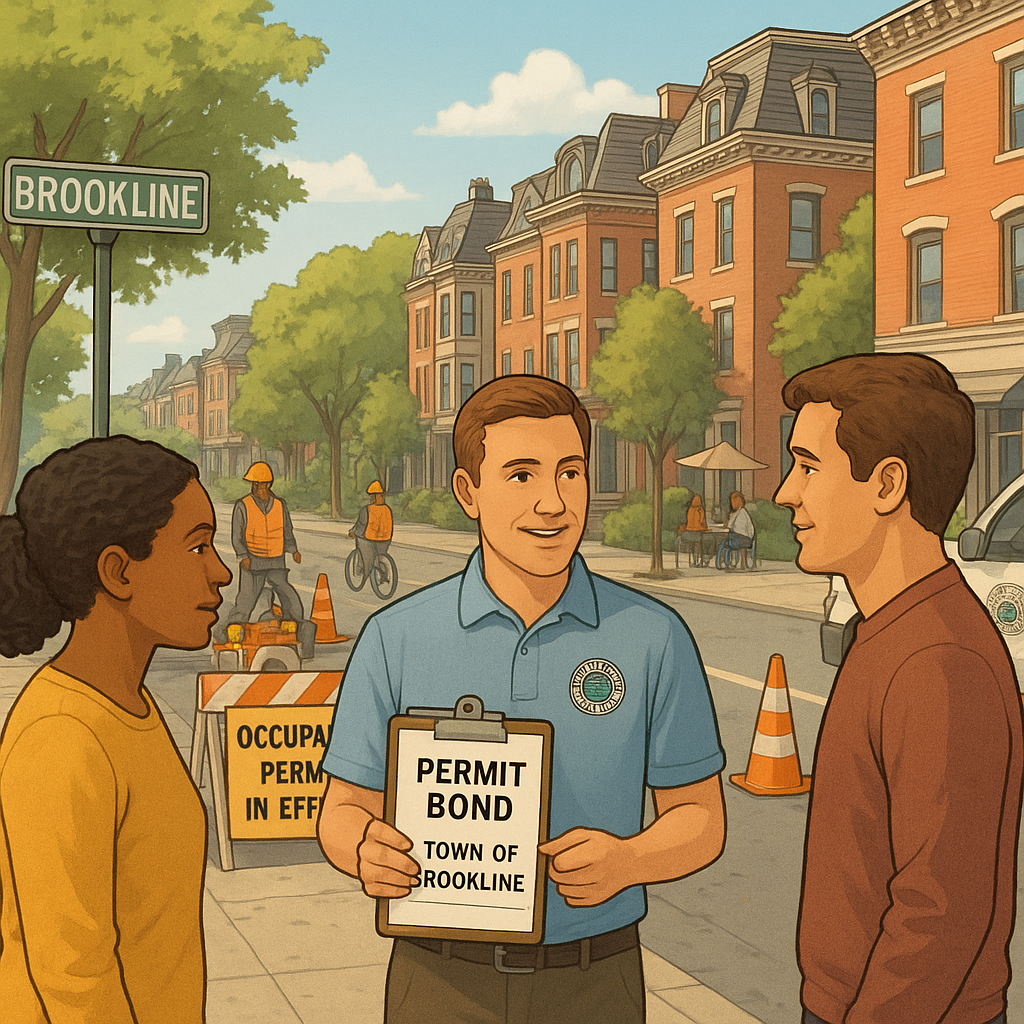
Have you ever driven through a quiet Brookline neighborhood only to see a crew digging up a section of the road or sidewalk? Maybe you wondered what sort of paperwork lets them close a lane, block a parking spot, or trench across a freshly paved street. If you are a contractor—or planning to become one—the answer almost always leads back to a small but mighty requirement: the Brookline street occupation permit bond. This guide breaks everything down in plain, friendly language so you can navigate the process without the headache.
First, What Exactly Is a Street Occupation Permit Bond?
Think of the bond as a financial promise, wrapped in a three-party safety net. It’s not insurance for your business. It’s a guarantee you purchase that protects the Town of Brookline, Massachusetts and its residents if something goes sideways during your work. The three parties are simple: you the contractor (the principal), the town (the obligee), and the surety company that backs the bond.
When you dig up a public street, sidewalk, or right-of-way, you’re borrowing public space. The town wants to make sure that when the job is done, everything gets put back the way it was—or better. If you don’t restore the area properly, leave a dangerous hole, or damage existing utilities, the bond can step in to cover the repair costs up to the bond’s limit. It’s like leaving a security deposit with a friend before borrowing their truck. You plan to return it in perfect shape, but the deposit gives them peace of mind.
Who Needs This Bond in Brookline?
In most cases, anyone performing work that disturbs a public way inside the Town of Brookline must secure a Brookline town permit bond. That includes:
- General contractors doing utility connections or street cuts.
- Plumbers replacing a water service line that runs under the sidewalk.
- Excavation and paving crews making trench repairs.
- Landscapers installing irrigation that crosses a public right-of-way.
- Utility companies, unless they have an annual blanket bond agreement.
The Department of Public Works (DPW) or the Engineering Division typically asks for the bond before issuing an occupation of street permit. Even a small job, like fixing a sewer lateral from the curb to the main, often triggers the requirement. If you’re not sure, a quick call to the town can save you from a last-minute scramble.
How Does the Bond Process Work, Step by Step?
Let’s walk through the journey from “I need to dig” to “permit in hand.” I’ll keep it as straightforward as a Saturday morning errand list.
1. Determine the Permit and Bond Amount
Brookline will tell you exactly which permit applies (like an occupation of street permit) and the required bond amount. Bond amounts are usually based on the scope of work. A small residential sidewalk repair might call for a $5,000 bond, while a major intersection overhaul could jump to $25,000 or more. The town sets the figure it thinks would cover worst-case restoration expenses.
2. Apply for the Bond Through a Surety Agency
You don’t have to tie up your own cash. You pay a small percentage—often between 1% and 10% of the bond total—to a surety company. For a $10,000 bond, you might only pay $100 to $300 if your credit and business finances are solid. That’s the beauty of a surety bond: you leverage the bonding company’s backing without draining your working capital.
3. Provide Basic Information
Applying is usually quick. You’ll share your business name, contact details, the project address, and the required bond amount. Some sureties may run a soft credit check for larger bonds. For many small and mid-sized Brookline permit bonds, the process can be completed online in a single afternoon.
4. Receive the Bond Form and File It
Once approved, the surety issues a bond document. You sign it as the principal and deliver it to the Town of Brookline, often at the DPW or Engineering office, before the permit is granted. Some agencies even provide a digital copy you can email, speeding things up nicely.
5. Get Your Permit and Get to Work
With the bond on file, the town processes your street occupation permit. Now you can start the job, confident that you’ve met all the legal boxes. Keep in mind the bond stays active until the town formally releases it, typically after inspecting and accepting the restoration work.
Why Does Brookline Require a Bond for Street Work?
It’s not about making life hard. The bond is a tool that keeps the town’s historic streets, modern utilities, and public safety in harmony. A few key reasons stand out:
- Protecting taxpayer dollars: If a contractor does a poor job and disappears, the town can use bond funds to fix the mess instead of burdening residents.
- Maintaining infrastructure quality: Brookline’s roads, sidewalks, and underground networks are tightly interwoven. A bad patch job can lead to potholes, water main breaks, or dangerous tripping hazards.
- Setting a standard of accountability: The requirement filters out fly-by-night operators and encourages contractors to follow proper cutting, backfilling, and paving methods.
- Protecting the public: An open trench with missing safety signage can lead to injuries. The bond creates a financial backstop tied directly to the permit holder’s responsibility.
When you see it from the town’s perspective, it’s a wise, proactive measure. And honestly, it makes a contractor look more professional to clients, too.
What Does a Brookline Street Occupation Bond Cost?
The cost makes most contractors breathe a sigh of relief. You’re not handing over the full bond amount—just the premium. For a well-qualified applicant, a $10,000 bond might cost $100 to $500 annually. Rates vary based on:
- Your personal credit score (for smaller bonds this is often the biggest factor).
- Your business financials and experience.
- The bond amount requested by Brookline.
- The surety company’s own underwriting appetite.
Many contractors bundle their Brookline MA permit bond with other municipal requirements across the Greater Boston area. If you frequently work in Newton, Cambridge, or Boston, a good surety agent can sometimes help you streamline multiple bonds, keeping costs predictable.
Common Pitfalls and How to Sidestep Them
Even a small oversight can delay your project and sour your relationship with the town. Here are the mistakes I see again and again—and how you can avoid them.
- Underestimating the bond amount. Don’t guess. Ask the town’s engineering department for a firm number based on your project’s specific footprint. A $5,000 assumption when they actually want $15,000 will only force you to reapply.
- Waiting until the last minute. Surety bonds are fast, but approval isn’t instantaneous for everyone. Apply at least a few business days before you plan to mobilize.
- Confusing a permit bond with insurance. Your general liability policy protects you. The bond protects Brookline. If you cause damage, the surety will pay the town and then come to you for reimbursement. That’s a critical distinction.
- Forgetting the bond release. After the work passes final inspection, ask the town to release or close your bond. This frees up your bonding capacity and lets you stop paying renewal premiums if the bond runs longer than expected.
- Not checking what counts as “public way.” Some contractors don’t realize that the grassy strip between the curb and sidewalk—often called the tree belt or parkway—can be town property. Disturb it without a bond, and you might face a stop-work order.
Real-Life Example: A Plumber’s Tuesday Morning
Let’s put this all into a story. Imagine Maria, a licensed plumber, gets a call to replace an old lead water service line from the main under the street up to a Brookline home. The job involves opening a trench in the asphalt, working around gas and electric lines, then restoring the pavement and sidewalk.
Before she can start, Brookline tells her she’ll need a $10,000 street occupation bond. Maria contacts a surety broker online, submits a short application, and pays a $150 premium. The bond arrives in her inbox before lunch. She drops it off at the DPW counter and walks out with her permit. Weeks later, the town’s inspector signs off on the paving, and Maria requests the bond release. Done. Without the bond, she would have lost days of work—and possibly the client.
Could she have done the same job without one? Technically no, and doing so would put her business license and reputation at risk.
Frequently Asked Questions, Answered Plainly
Is the bond the same thing as a “permit bond” or “license bond”?
In this context, yes. Brookline’s street occupation permit bond is a type of permit bond required specifically for opening or occupying the public right-of-way. Some towns call it a street opening bond, trench bond, or right-of-way bond. It all serves the same purpose.
Can I use my existing general contractor bond?
Probably not. A general contractor license bond covers compliance with building codes and state regulations. Brookline wants a specific bond tied to the physical restoration of the street. However, if you have a blanket bond already approved by the town, you may not need a single-job bond each time. Check with the Engineering Division.
What happens if there’s a claim against my bond?
If the town files a claim—for unpaid inspection fees, defective restoration, or damage to municipal utilities—the surety will investigate. If the claim is valid, the surety pays the town up to the bond’s limit. Then, you must repay the surety every penny. It’s not a gift; it’s a credit line you’re obligated to reimburse.
How long does the bond last?
The bond remains active until the town formally accepts the work and releases the obligation. Some bonds may have an expiration date (typically one year), but they can be renewed if the project runs long. Don’t walk away without that release—it can come back to haunt you.
Does a small handyman job need this bond?
If the work stays entirely on private property and doesn’t touch the sidewalk, street, or town right-of-way, you generally won’t need it. But the moment your shovel crosses the property line into what Brookline considers public space, the rules change. When in doubt, ask the DPW; they’re surprisingly helpful.
Your Next Move: Securing a Brookline MA Permit Bond with Confidence
Understanding the Town of Brookline, Massachusetts permit bond for street occupation doesn’t have to feel like navigating a maze blindfolded. It’s a straightforward system designed to keep everyone safe and streets in good shape. For contractors, it’s one more tool that builds trust and keeps projects humming.
When you approach the process early, work with a reputable surety agent, and mind the details—specifically the bond amount and release—you transform a regulatory hurdle into a simple, affordable step. So the next time you need to cut into a historic Brookline street, you’ll have the bond in hand, the permit on the dash, and a whole lot less stress. After all, a little paperwork upfront is worth a smooth, pothole-free result for the entire neighborhood.