Enfield, Connecticut requires contractors to obtain both an excavation permit bond and a third-party liability bond before beginning any digging work. The permit bond guarantees the town that public infrastructure will be repaired and regulations followed, while the liability bond protects neighboring private property owners from damage or injury.
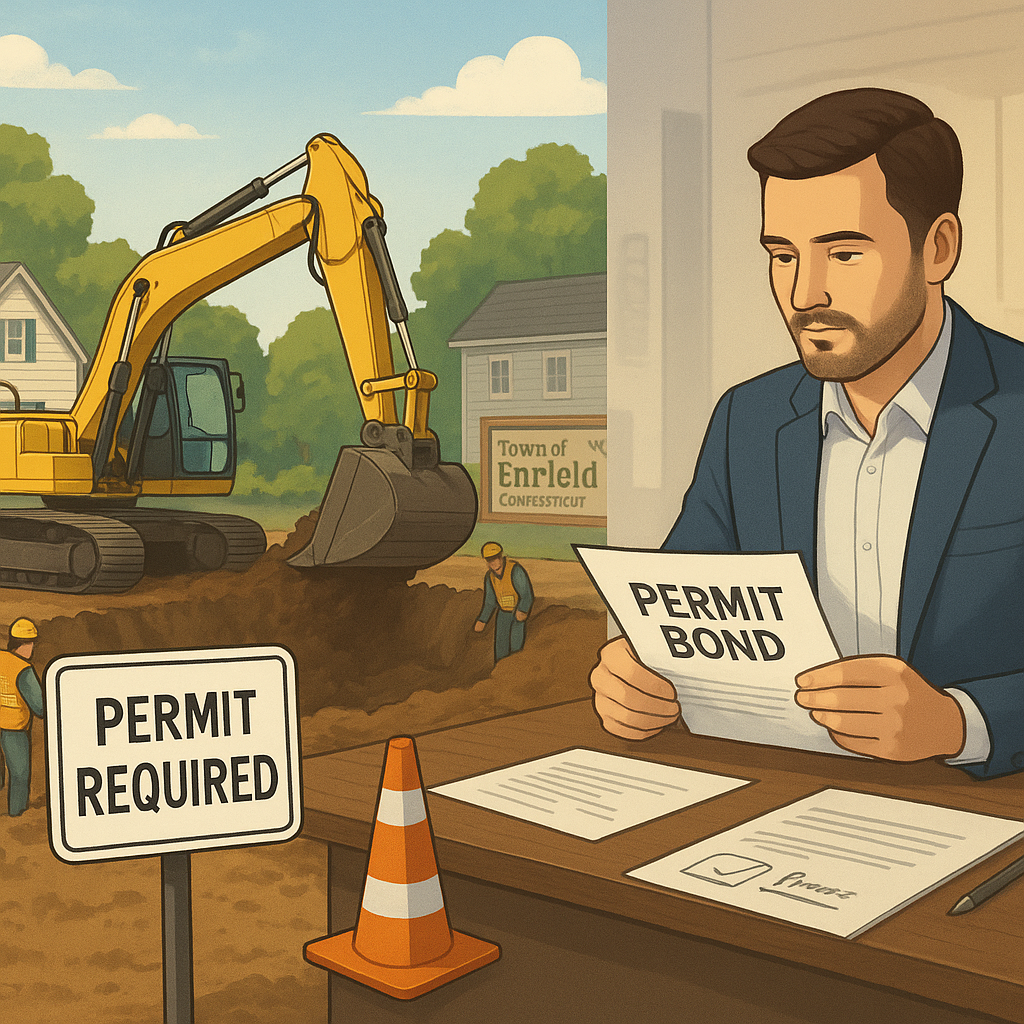
Have you ever watched a backhoe tear up a quiet Enfield street and wondered, “What happens if something goes wrong?” Whether it’s a new sewer line, a swimming pool, or a foundation dig, excavation work comes with real risks. That’s why the Town of Enfield, Connecticut, requires contractors to carry specific bonds before they can pull a permit. Let’s unpack the two most important ones you’ll hear about: the Enfield CT excavation permit bond and the third-party liability bond.
What Is an Excavation Permit Bond in Enfield, CT?
Think of an excavation permit bond as a financial promise card you hand to the town. It’s not insurance for the contractor—it’s a guarantee for the community. When a contractor purchases this bond, they’re telling Enfield, “I will follow all local rules, complete the work safely, and leave public property just as I found it.” If they don’t, the town can make a claim against that bond to fix any damage.
These bonds fall under the umbrella of surety bonds. They involve three parties: the contractor (called the principal), the Town of Enfield (the obligee), and the surety company that backs the bond. The bond is a must-have before the Building Department issues an excavation permit. Without it, no digging can legally begin.
What Does the Excavation Permit Bond Cover?
- Repairing roads, sidewalks, or curbs damaged during construction.
- Restoring public utility strips and landscaping to their original condition.
- Filling trenches and excavations properly to prevent sinkholes or pavement collapse later on.
- Following all permit conditions, including work hours, site safety, and restoration deadlines.
In short, the bond protects the town’s infrastructure and keeps contractors accountable long after the shovels are put away.
The Role of a Third-Party Liability Bond
Now, what about damage that happens to private property next door? That’s where the third-party liability bond steps in. While the excavation permit bond focuses on public spaces, this bond safeguards your neighbors and anyone else who might be affected by the work.
Excavation, by its very nature, can cause vibration, soil movement, or accidental utility strikes. A third-party liability bond gives surrounding property owners a clear path to compensation if something unintended occurs. Picture this: a contractor is digging a trench for a new water main and inadvertently undermines your fence footing, causing a section to tumble. The third-party bond provides funds to make things right without a drawn-out legal battle.
Common Scenarios Where This Bond Matters
- Damage to an adjacent building’s foundation from soil settlement.
- Breaking a privately owned sewer lateral or irrigation line.
- Injury to a passerby caused by falling debris or an unsecured trench.
- Vehicle damage from uneven road plates or spilled fill material.
By requiring this bond, Enfield ensures that construction doesn’t become a burden on innocent neighbors. It’s a quiet safety net that keeps community relationships strong while projects move forward.
Why These Bonds Matter to You (and Your Neighbors)
You might be thinking, “I’m just a homeowner looking to add a garage. Do I really need to know all this?” The answer is a gentle yes. Even if you hire a professional contractor, understanding these bonds helps you ask the right questions before signing a contract.
For contractors, carrying both an excavation permit bond and a third-party liability bond shows professionalism and reliability. It tells clients and town officials that you take your responsibilities seriously. For Enfield residents, these bonds are a promise that their streets won’t be left torn up and that any accidental damage to their property will be handled fairly.
How Do These Bonds Work? A Simple Breakdown
Let’s walk through a real-world example without the legalese. Imagine Sarah, an excavation contractor, gets hired to install a drainage system on a residential lot in Enfield. She heads to Town Hall and applies for an excavation permit. The clerk explains she needs two bonds: an excavation permit bond for $10,000 and a third-party liability bond for a similar amount. Sarah contacts a surety bond agency, pays a small premium—often just a fraction of the total bond amount—and the bonds are issued. She’s now legally covered to start digging.
Midway through the project, a heavy rain softens the soil around the trench, and a portion of the neighbor’s driveway sinks. The neighbor files a claim against Sarah’s third-party liability bond. If the claim is valid, the surety company pays out to repair the driveway, up to the bond limit. Sarah then repays the surety company because, remember, a bond is a form of credit, not an insurance policy. This system keeps everyone honest.
How Much Does an Excavation Permit Bond Cost in Enfield?
Costs vary, but here’s the good news: you don’t have to pay the full bond amount upfront. The premium you pay is based on the bond’s total value, your credit history, and business financials. For a typical $10,000 excavation permit bond, a well-qualified contractor might pay between $100 and $300 annually. That small investment unlocks the ability to work legally in town, and it signals to customers that you’re licensed, bonded, and insured—a triple win.
Third-party liability bond premiums work similarly. They’re usually calculated as a percentage of the coverage amount. Many surety companies even offer package deals when you need both bonds for the same Enfield project. Keep in mind, the town sets the required bond amounts, so always check the latest permit application or call the Enfield Building Department to confirm what you need.
Steps to Secure Your Enfield Excavation Bond
Getting bonded doesn’t have to be a headache. Follow these straightforward steps, and you’ll have your paperwork ready in no time.
- Determine the required bond type and amount. Contact the Town of Enfield’s Building or Engineering Department. They’ll tell you the exact excavation permit bond and third-party liability bond limits for your specific job.
- Gather your business information. You’ll typically need your contractor’s license number, business address, and possibly financial statements. The surety company uses this to assess risk.
- Request a quote from a reputable surety bond agency. Look for companies experienced in Connecticut contractor bonds. They’ll understand Enfield’s local requirements and can often turn around a quote within hours.
- Pay the premium and sign the indemnity agreement. Once approved, you’ll finalize the paperwork. The agency will then issue the bond documents electronically or by mail.
- Submit your bond to the town. Bring the original bond form when you apply for your excavation permit. Keep a copy for your records—it’s proof of compliance.
What If I Dig Without a Permit or Bond?
Skipping the permit and bonding process might be tempting to save a few dollars, but the consequences can be severe. Enfield code enforcement officers regularly inspect job sites. If you’re caught excavating without the proper bonds, you could face stop-work orders, hefty fines, and even a revocation of your right to work in town. Worse, if an accident happens and you’re uninsured and unbonded, you’ll be personally liable for all damages. That backyard trench could quickly become a financial nightmare.
Frequently Asked Questions About Enfield Excavation Bonds
Is a third-party liability bond the same as general liability insurance?
No. Insurance protects the contractor from their own losses and pays out without requiring repayment. A bond is a guarantee that the contractor will perform as promised; if a claim pays out, the contractor must reimburse the surety company. Both serve different purposes, and many Enfield projects require both.
Do I need a new bond for every job?
Not necessarily. Some contractors maintain a blanket excavation permit bond that covers multiple projects throughout the year. The third-party liability bond might be job-specific, especially if the town requests different coverage amounts for larger or riskier excavations. Confirm with Enfield officials before assuming your existing bond is sufficient.
How can a homeowner verify that a contractor is properly bonded?
Ask to see the bond documents. A legitimate contractor will be happy to show you the certificate. You can also contact the Town of Enfield’s building department to confirm that the permit is active and that all required bonds are on file. A quick phone call can save you from a world of trouble.
What happens if a claim exceeds the bond limit?
The bond only covers up to its face value. If damages exceed that amount, the contractor is responsible for the remainder. That’s why it’s wise for contractors to carry sufficient coverage and for homeowners to know the bond limit before work begins.
Protecting Our Town, One Dig at a Time
Excavation is the hidden backbone of nearly every construction project—from a simple trench for a new utility line to the foundation of a community center. The Enfield CT excavation permit bond and the companion third-party liability bond ensure that this work leaves the community better, not worse. They’re more than just paperwork; they’re a shared commitment between contractors, the town, and residents to build and repair responsibly.
Whether you’re an experienced excavator or a homeowner preparing for a renovation, knowing the bond requirements puts you a step ahead. It keeps the process smooth, the streets safe, and our neighborhoods strong. Next time you see that backhoe, you’ll understand the invisible safety nets working beneath the surface.