Starting an employment agency in New York City requires a license from the Department of Consumer and Worker Protection, which often includes securing a third-party surety bond. This bond serves as a financial safety net, ensuring that agencies compensate victims if they violate regulations, with the agency ultimately repaying the surety company.
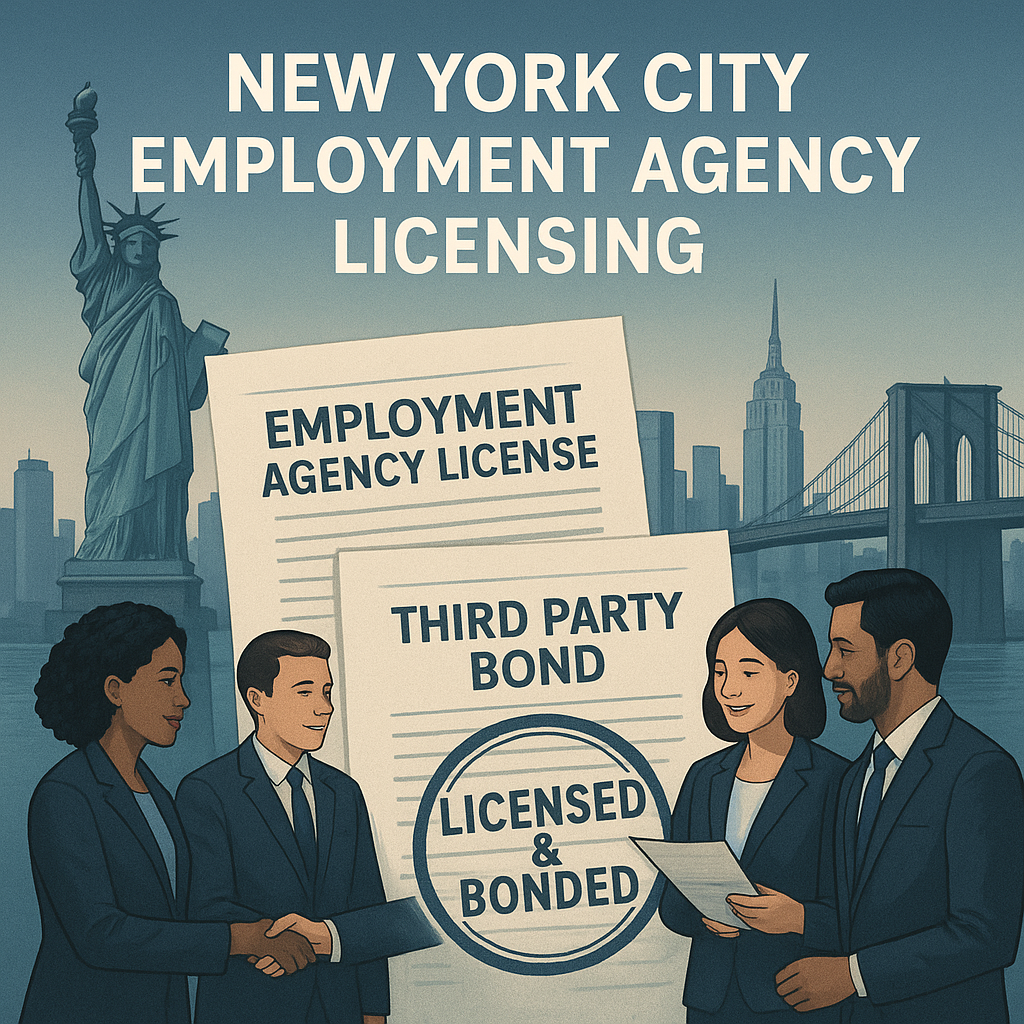
Starting an employment agency in New York City can feel like navigating a maze of paperwork. Between filing forms, paying fees, and understanding local rules, it’s easy to get lost. One requirement that often raises eyebrows is the third-party bond tied to the NYC Employment Agency License. If you’re picturing something out of a spy movie, relax. It’s actually a simple consumer protection tool that anyone can grasp with a little explanation.
This guide breaks down the who, what, and why of the New York City Employment Agency License and its required bond. We’ll leave the legal jargon at the door and focus on real-world answers you can use.
What Exactly Is an Employment Agency License in New York City?
Picture this: you run a business that connects job seekers with employers. Maybe you place nannies with families, send temporary office workers to companies, or help recent graduates land their first professional roles. In New York City, any individual or company that does this for a fee needs a license from the Department of Consumer and Worker Protection (DCWP) — formerly known as the Department of Consumer Affairs.
The license isn’t just a piece of paper. It signals that your agency meets specific standards and has agreed to follow the city’s rules designed to protect both workers and clients. Without it, operating an employment agency is illegal and can lead to stiff fines or being shut down entirely.
But there’s a catch: before the DCWP will issue your license, they often require you to provide a third-party surety bond. Think of the bond as a financial promise that you’ll play fair. If you don’t, there’s money available to make things right.
The Third-Party Bond: Your Agency’s Safety Net
Many entrepreneurs freeze when they hear the word “bond.” Isn’t that something for construction companies or giant corporations? Not at all. In this context, a third-party bond is a three-way agreement between your employment agency (the principal), a surety company (the bond provider), and the city of New York (the obligee). The bond protects the city and the public — the third parties — from financial harm caused by your agency’s misconduct.
How Does a Third-Party Bond Work in the Real World?
Let’s use a relatable example. Imagine an agency charges a job seeker an upfront fee, promises them a role, and then never delivers. Or maybe the agency misclassifies a worker, leaving them with unpaid wages. The injured party — the worker, the employer, or the city — can file a claim against the bond. If the claim is valid, the surety company pays out up to the bond’s full value. The agency must then repay every penny to the surety. In other words, the bond doesn’t protect the agency from its own mistakes; it ensures the victims don’t walk away empty-handed.
This mechanism is why many people call a surety bond a form of credit. You promise to follow the rules, and if you break that promise, someone else will cover the bill temporarily — but you’re still on the hook.
Who Needs This License and Bond?
The requirement covers a surprisingly wide range of businesses. If you engage in any of the following activities for a fee, pay attention:
- Permanent placement agencies that match candidates with full-time jobs.
- Temporary staffing agencies that supply workers to other businesses.
- Nanny or domestic worker agencies placing caregivers, housekeepers, or drivers.
- Modeling and talent agencies (except those covered by a separate state law).
- Nursing registries that refer healthcare professionals.
- Consulting firms that offer placement services, even if that’s only a small part of what you do.
There’s a good rule of thumb. Ask yourself: does a third party rely on my promise to find them work or provide workers? If the answer is yes, a New York City employment agency license and a third-party bond likely apply.
Bond Amounts: How Much Coverage Do You Need?
This is where things get specific. The bond amount isn’t a one-size-fits-all figure. New York City splits employment agencies into different classes, and each class has its own required bond amount. Common classifications include:
- Class A: Agencies that place domestic or household employees (nannies, cleaners) often need a $5,000 bond.
- Class B: Agencies that place workers in commercial or industrial settings might need a $10,000 bond.
- Class C: Agencies that charge job seekers for resume help or job listings, also known as “employment counseling” services, can face bond requirements up to $25,000.
These figures are not just random. They reflect the level of risk and the potential financial harm a bad actor could cause. Always confirm the exact amount with the DCWP or a bond specialist, because misclassifying your agency can delay your license.
One more thing: you don’t need to pay the full bond amount out of pocket. You pay a small premium, usually a percentage of the total sum. For someone with good credit, a $5,000 bond might cost as little as $100 per year. That’s a surprisingly affordable price for the trust and legality it buys.
Step-by-Step: Getting Licensed and Bonded
Feeling ready to tackle the process? Here’s a roadmap that turns a daunting task into manageable bites.
1. Determine Your Agency Classification
Head to the DCWP website or call their office. Ask about the specific license class that matches your services. Getting this wrong can waste weeks of back-and-forth.
2. Gather Required Documents
You’ll typically need photo IDs for all owners, proof of business registration with New York State, and a detailed explanation of your fee structure. The city wants transparency for consumers.
3. Purchase Your Third-Party Bond
Contact a licensed surety bond provider. They’ll ask for basic business information and run a quick credit check. Once approved, you’ll pay the premium and receive a bond form — often within 24 hours. Make sure the bond lists the city of New York as the obligee.
4. Submit Your Application and Bond
File everything online through the DCWP portal or in person. Don’t forget the licensing fee. The bond must remain active for the entire license period, usually two years.
5. Renew on Time, Every Time
Mark your calendar. The renewal process is similar. If your bond lapses, your license can be suspended, even if you’re in the middle of a banner year.
What Happens If You Skip the Bond?
Skipping a required third-party bond is like driving without insurance. You might get away with it for a while, but the consequences can be severe. The DCWP conducts regular inspections and follows up on consumer complaints. Operating without a bond can trigger fines starting at $500 and climbing fast. In extreme cases, the city can padlock your doors and revoke your right to operate altogether.
Beyond the legal blow, consider the reputational damage. Clients and candidates are savvier than ever. Many check if an agency holds a valid license and bond before handing over sensitive personal data or money. A missing bond instantly raises red flags.
Why This Bond Is Good for Your Business
It’s easy to view a bond as just another bureaucratic hurdle. Flip the lens, though, and you’ll see a marketing advantage. Displaying “Bonded and Licensed” on your website and in your contracts tells a story. It says, “We’ve been vetted. We stand behind our promises. If something goes wrong, you have a way to recover your losses.”
In a city crowded with employment agencies, that kind of trust can be the difference between a phone that rings constantly and one that stays silent. Large corporate clients often require proof of bonding before they’ll sign a contract. You’re not just checking a box; you’re opening doors.
Common Questions About NYC Employment Agency Bonds
Can I use a property bond instead of a surety bond?
No. New York City specifically requires a surety bond from an authorized carrier. Personal assets or cash deposits won’t satisfy the rule.
What if my credit isn’t perfect?
You can still get bonded. Some providers offer programs for applicants with challenged credit. The premium might be higher, but a decline isn’t inevitable. Discuss your situation honestly with a bond agent.
Does the bond cover every kind of dispute?
Not always. It typically covers violations of the employment agency law itself — improper fees, misrepresentation, failure to pay wages, and similar issues. A breach of a complex staffing contract might need to be resolved through the courts instead.
How do claims actually work?
A consumer or worker files a complaint with the DCWP. The city investigates. If they find a violation and the agency refuses to make things right, they can make a claim on the bond. The surety investigates and, if the claim stands, pays out. Then they pursue the agency for reimbursement.
A Simple Analogy to Tie It All Together
Think of the New York City employment agency license as your driver’s license, and the third-party bond as your car insurance. You need the license to get behind the wheel legally. The insurance doesn’t prevent accidents, but it protects others if you cause one. Without it, you’re taking a huge risk every time you pull onto the road. The city wants safe drivers — and honest, responsible employment agencies.
Next Steps for Your Agency
Take a breath. The process is straightforward once you line up the pieces. Start by visiting the DCWP’s online licensing center to download the checklist for your business type. Then, grab a quote from a surety bond specialist who knows the local landscape. With the license and bond in hand, you’ll join a league of professionals who take their duty to both workers and clients seriously. Your agency isn’t just built on placements — it’s built on trust, backed by a bond that proves it.